The 8 Canary Islands: Overview
The Canary Islands are an archipelago of 8 inhabited islands in the Atlantic Ocean, off the coast of Africa. They belong to Spain and therefore the European Union, but have a special tax regime: instead of standard VAT, they apply IGIC at 7%, making everything slightly cheaper than mainland Spain.
All islands share an eternal spring climate, with average temperatures of 18-24°C year-round and over 300 days of sunshine. Yet each island has a radically different personality. From cosmopolitan cities to islands with no paved roads, there is a Canary Island for every type of traveller.
Key facts for the entire archipelago:
- Currency: Euro
- Language: Spanish
- Tax: IGIC 7% (instead of 21% VAT)
- Climate: Subtropical, 18-24°C year-round
- Direct flights: From across Europe, with frequent inter-island connections
- Healthcare: European health card accepted
Gran Canaria
"The Miniature Continent." Gran Canaria is the most well-rounded island in the archipelago. Covering 1,560 km² with 850,000 inhabitants, it offers absolutely everything: golden sand beaches, desert dunes, laurel forests, volcanic peaks, a vibrant capital, and charming villages.Why it stands out
- Las Canteras: One of Europe's best urban beaches with 3.2 km of golden sand right in the capital
- Maspalomas Dunes: 8 km² of dunes that look like a mini Sahara
- Roque Nublo: Basalt monolith at 1,813 m with views across to Mount Teide
- Las Palmas de Gran Canaria: Cosmopolitan city with 380,000 inhabitants, superb food scene, culture, and nightlife
- Digital nomad hub: Coworking spaces, international community, high-speed fibre broadband
Practical info
- Population: 850,000
- Airport: LPA (Gran Canaria), direct flights from across Europe
- Average temperature: 21-24°C depending on area
- Best for: Everyone. Families, couples, digital nomads, surfers, nature lovers
Gran Canaria is the only island where you can have breakfast by the sea, go surfing, lunch in a mountain village, visit a museum, and dine at a fine restaurant, all in the same day.
Tenerife
The largest island in the Canaries at 2,034 km² with 928,000 inhabitants. Tenerife is an island of extreme contrasts: from the touristy beaches of the south to the ancient forests of the north, all dominated by Mount Teide, Spain's highest peak.Why it stands out
- Mount Teide: 3,718 metres, Spain's tallest volcano and a UNESCO World Heritage Site. Cable car to 3,555 m
- Two airports: Tenerife South (TFS, tourist hub) and Tenerife North (TFN, domestic)
- Playa de las Americas and Los Cristianos: Tourist resorts with guaranteed sunshine
- La Laguna: University city and UNESCO World Heritage Site
- Siam Park: Voted the world's best water park
- Anaga: Ancient laurel forest (UNESCO Biosphere Reserve)
Practical info
- Population: 928,000
- Airports: TFS (south) and TFN (north)
- Average temperature: 20-25°C depending on area
- Best for: Nature lovers, resort-goers, families
Tenerife has more tourist infrastructure than any other island, but also more overcrowding in the southern resort zones. The north is green and authentic; the south is dry and purpose-built for tourism.
Lanzarote
The island of art and volcanoes. At 845 km² with 155,000 inhabitants, Lanzarote is a lunar landscape declared a UNESCO Biosphere Reserve. The legacy of artist Cesar Manrique is everywhere, blending art and nature in a way found nowhere else.Why it stands out
- Timanfaya: National Park of volcanic landscapes where the ground reaches 600°C just metres below the surface
- Cesar Manrique: Jameos del Agua, Mirador del Rio, Manrique Foundation - architecture woven into the lava
- La Geria: Unique wine region where vines grow in hollows dug into volcanic ash
- Unspoilt beaches: Papagayo, Famara - far less crowded than other islands
- Protected architecture: Island-wide restrictions preserve the landscape (no tall buildings, no advertising billboards)
Practical info
- Population: 155,000
- Airport: ACE (Lanzarote)
- Average temperature: 21-25°C
- Best for: Art lovers, photographers, couples, cultural travellers
Lanzarote is the most "designed" island in the Canaries. If aesthetics, photography, and culture matter to you, this is your island.
Fuerteventura
The island of endless beaches. At 1,659 km² it is the second-largest island, yet has only 120,000 inhabitants. Fuerteventura boasts over 150 km of coastline with some of the longest, most pristine beaches in Europe.Why it stands out
- Endless beaches: Cofete, Sotavento, Corralejo - kilometres of white sand, often nearly empty
- Windsurfing and kitesurfing capital: Constant wind, world championships at Sotavento
- Corralejo Natural Park: Spectacular dunes with Lobos Island just offshore
- Betancuria: Former capital, one of the most charming villages in the Canaries
- Desert landscapes: Arid plains reminiscent of North Africa
Practical info
- Population: 120,000
- Airport: FUE (Fuerteventura)
- Average temperature: 21-25°C
- Best for: Beach lovers, surfers, families seeking peace and quiet
Fuerteventura is the most "empty" of the main islands. If you want beaches without crowds and room to breathe, you will find it here.
La Palma
"La Isla Bonita" (The Beautiful Island), and it earns the name. At 708 km² with 83,000 inhabitants, La Palma is the greenest and most mountainous island in the archipelago. Known for its pristine skies and untouched nature, it experienced a volcanic eruption in 2021 that added dramatic new landscapes.Why it stands out
- Roque de los Muchachos: Astrophysical observatory at 2,426 m, one of the world's premier stargazing locations
- Caldera de Taburiente: Giant crater 8 km across with waterfalls and forests
- Starlight Reserve: Certified Starlight Reserve with light pollution regulated by law
- Tajogaite Volcano: 2021 eruption site, recent lunar landscapes open for visits
- Laurel forests: Los Tilos, prehistoric forests with giant ferns
Practical info
- Population: 83,000
- Airport: SPC (La Palma)
- Average temperature: 19-23°C
- Best for: Hikers, stargazers, nature purists
La Palma is not a beach holiday island. It is for those who want to walk incredible trails, sleep under star-filled skies, and genuinely disconnect.
La Gomera
The wildest of the main islands. At just 370 km² with 22,000 inhabitants, La Gomera is a hiker's paradise free from mass tourism. This is the island where Columbus made his final stop before crossing the Atlantic.Why it stands out
- Garajonay: National Park and UNESCO World Heritage Site. A cloud forest of laurel trees shrouded in mist, an ecosystem from the Tertiary era
- Silbo Gomero: The world's only whistled language, a UNESCO Intangible Heritage, still taught in schools
- Valle Gran Rey: Laid-back village with quiet beaches
- No mass tourism: No large resorts, no international chains
- Ferry access: 50 minutes from Tenerife (Fred. Olsen Express)
Practical info
- Population: 22,000
- Airport: GMZ (inter-island flights only)
- Average temperature: 19-23°C
- Best for: Hikers, eco-travellers, those seeking authenticity
La Gomera is the anti-tourist island. No fast food chains, no nightclubs, no all-inclusive resorts. Just nature, small villages, and silence.
El Hierro
The island at the edge of the world. At 268 km² with just 11,000 inhabitants, El Hierro is the smallest and most remote island in the archipelago. It is the world's first island to be 100% self-sufficient on renewable energy (wind + hydro).Why it stands out
- 100% renewable energy: Gorona del Viento wind-hydro plant, a global benchmark in sustainability
- Marine reserve: Mar de las Calmas, one of Europe's best dive sites with crystal-clear water and abundant marine life
- Garoe Tree: Sacred tree of the Bimbache (indigenous people) that condensed water from fog
- El Sabinar: Trees twisted into surreal shapes by the wind
- No crowds: It is nearly impossible to find a busy spot
Practical info
- Population: 11,000
- Airport: VDE (inter-island flights) or ferry from Tenerife
- Average temperature: 19-22°C
- Best for: Off-grid travellers, divers, sustainability enthusiasts
El Hierro is for those who want to drop off the map for a few days. No organised tourism, no rush, no noise.
La Graciosa
The eighth island. At just 29 km² with 750 inhabitants, La Graciosa is the smallest island and was officially recognised as the eighth inhabited island in 2018. It has no paved roads - only sandy tracks.Why it stands out
- Pristine beaches: La Francesa, Las Conchas - turquoise crystal-clear waters with zero development
- Virtually car-free: Only authorised vehicles allowed; explore by bike or on foot
- Caleta de Sebo: The only village, with sandy streets and white houses
- Day trip from Lanzarote: 25-minute ferry from Orzola
- Chinijo Archipelago Natural Park: Total environmental protection
Practical info
- Population: 750
- Airport: None. Ferry from Lanzarote only (25 min)
- Average temperature: 21-25°C
- Best for: Day trippers, beach purists
La Graciosa is a perfect day trip from Lanzarote. There are no hotels above two stars and no white-tablecloth restaurants. Just sand, sea, and silence.
Comparison Table
| | Gran Canaria | Tenerife | Lanzarote | Fuerteventura | La Palma | La Gomera | El Hierro | La Graciosa |
|---|---|---|---|---|---|---|---|---|
| Population | 850,000 | 928,000 | 155,000 | 120,000 | 83,000 | 22,000 | 11,000 | 750 |
| Area | 1,560 km² | 2,034 km² | 845 km² | 1,659 km² | 708 km² | 370 km² | 268 km² | 29 km² |
| Airport | LPA | TFS / TFN | ACE | FUE | SPC | GMZ (inter-island) | VDE (inter-island) | None |
| Best beach | Las Canteras | Las Teresitas | Papagayo | Cofete | Nogales | Valle Gran Rey | Tacoron | Las Conchas |
| Top attraction | Roque Nublo + Dunes | Teide (3,718 m) | Timanfaya | Endless beaches | Observatory | Garajonay | Diving | Pristine beaches |
| Best for | Everyone | Nature, families | Art, couples | Beach, surfing | Hiking, stargazing | Hiking, eco | Diving, off-grid | Day trips |
| Accommodation cost | €70-150/night | €70-200/night | €60-150/night | €50-130/night | €50-100/night | €45-90/night | €40-80/night | €50-90/night |
| Crowd level | Medium-high | High | Medium | Medium-low | Low | Very low | Minimal | Minimal |
Our Recommendation
After comparing all 8 islands, our conclusion is straightforward: Gran Canaria is the best island for most travellers. It is not the cheapest or the quietest, but it is the only one that truly has everything.
Why? Because in Gran Canaria you can:
- Enjoy urban and wild beaches on the same day (Las Canteras in the morning, Gui Gui in the afternoon)
- Combine city life and nature without compromising either
- Eat like a local at authentic restaurants in Las Palmas
- Surf, dive, hike and enjoy nightlife
- Connect with an international community of digital nomads
- Use efficient public transport to explore the entire island
And if you want the best possible base, Las Canteras is the place. A 3.2 km beach in the heart of the capital, with everything on foot and direct connections to the whole island.
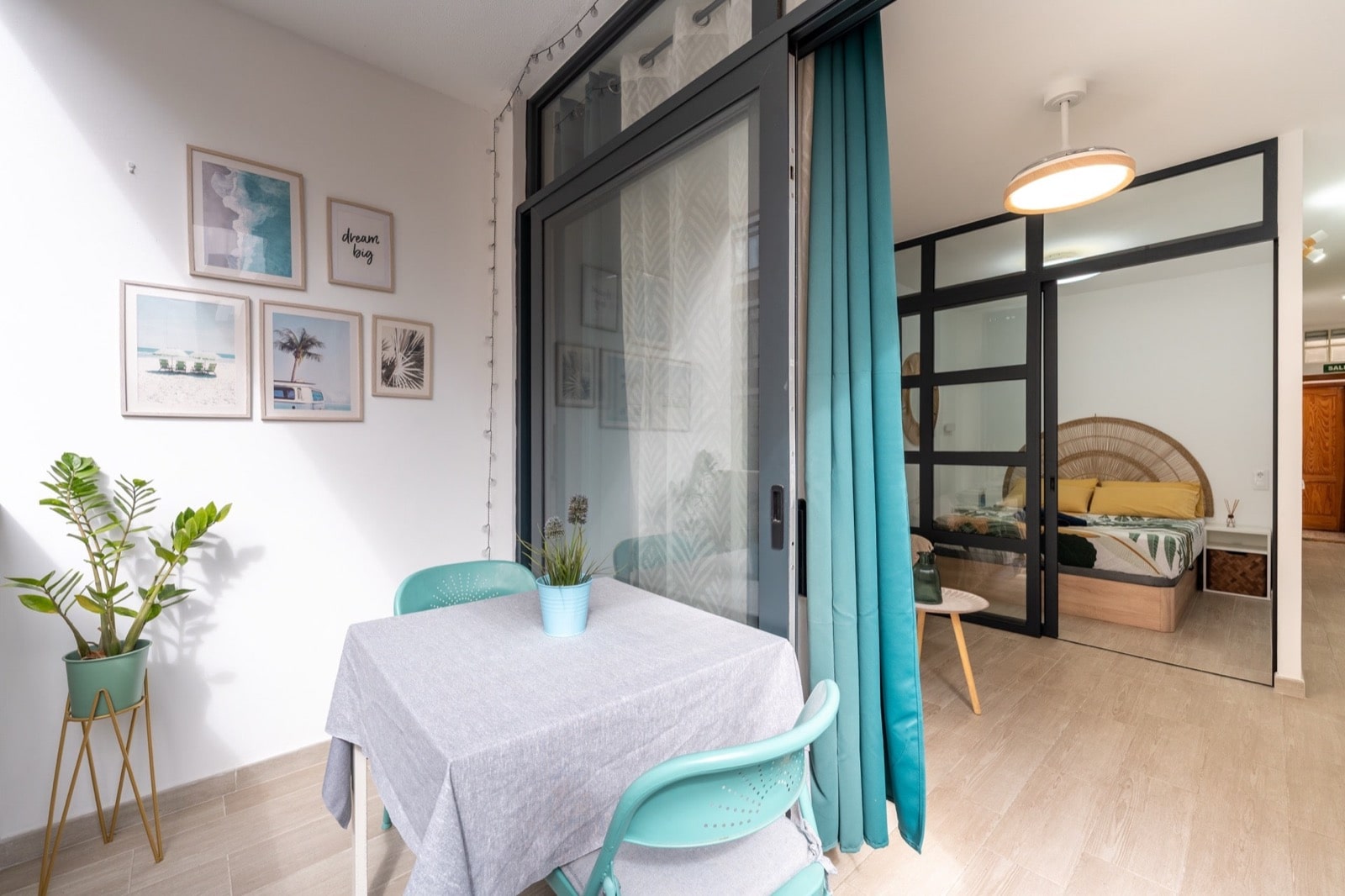
From Casita Palmera, our apartment just 30 metres from Las Canteras, you will have the ideal base to explore not just Gran Canaria, but the entire archipelago. Inter-island flights start from €25 and take between 25 and 50 minutes.
Frequently Asked Questions
Which Canary Island is cheapest?
El Hierro and La Gomera have the most affordable accommodation (from €40-45/night), but options are limited. Among the major islands, Fuerteventura offers the best value with apartments from €50/night.Which Canary Island has the best weather?
All have excellent weather, but Fuerteventura and the south of Gran Canaria/Tenerife get the most sunshine hours and the least chance of rain. La Palma and La Gomera are slightly cooler and more humid due to their lush vegetation.
Can you island-hop in the Canaries?
Yes. There are inter-island flights with Binter and Canaryfly (from €25, 25-50 minutes) and ferries with Fred. Olsen and Naviera Armas (from €20). The most frequent connections are Gran Canaria-Tenerife, Tenerife-La Gomera, and Lanzarote-Fuerteventura.