What is Spain's Digital Nomad Visa
Since January 2023, Spain offers a dedicated visa for digital nomads through Law 28/2022, known as the Startup Law. This permit allows non-EU professionals to legally reside in Spain while working remotely for foreign companies or as freelancers with international clients.
Spain's digital nomad visa has quickly become one of Europe's most attractive options thanks to its combination of tax benefits, quality of life and straightforward application process. Unlike other European programs, Spain offers significant tax advantages that can substantially reduce your tax burden during the first years of residency.
Key Visa Facts
| Aspect | Detail |
|--------|--------|
| Initial duration | 1 year (visa) or 3 years (residence permit) |
| Renewal | Up to 5 years total |
| Processing time | 20 business days |
| Application fee | Approx. €80 (consular fee) |
| Program start | January 2023 |
| Legal basis | Law 28/2022 (Startup Law) |
---
Eligibility Requirements
To apply for Spain's digital nomad visa, you must meet the following criteria:
Financial Requirements
- Minimum income: €2,520/month (equivalent to 200% of Spain's minimum wage in 2026)
- Income source: Remote work for a non-Spanish company or international clients
- Spanish client limit: Maximum 20% of your income may come from Spanish companies
- Employment history: At least 1 year of professional relationship with your current employer or clients
Personal Requirements
- Nationality: Citizens of non-EU/EEA countries (EU citizens do not need this visa)
- Criminal record: Clean certificate for the past 5 years
- Health insurance: Full coverage valid in Spain from an authorized insurer
- No prior residency: Must not have been a tax resident in Spain during the last 5 years (to access the special tax regime)
Professional Requirements
- Qualifications: University degree or professional training, or at least 3 years of relevant professional experience
- Contract or activity: Remote work contract with a foreign company or registered freelance activity
---
Step-by-Step Application Process
Step 1: Gather Your Documentation
Before starting your application, prepare all required documents. Most must be apostilled and translated into Spanish by a sworn translator.
Step 2: Submit Your Application
You have two options for submitting your application:
- From abroad: At the Spanish consulate or embassy in your country of residence
- From within Spain (if you are on a tourist visa): At the Large Companies and Strategic Groups Unit (UGE-CE)
Step 3: Wait for the Decision
The official processing time is 20 business days. If you do not receive a response within this period, the application is considered approved through positive administrative silence.
Step 4: Obtain Your NIE and Residence Card
Once your visa is approved, you will need to:
Step 5: Activate the Special Tax Regime
If you meet the requirements, apply for the Beckham Law regime at the Spanish Tax Agency within 6 months of registering with Spanish Social Security.
---
Required Documents
Prepare the following documentation:
- Valid passport with at least 1 year of remaining validity
- Criminal record certificate, apostilled and translated
- Employment contract with a foreign company or proof of freelance activity
- Proof of income for the past 12 months (bank statements, payslips)
- Health insurance with coverage in Spain
- University degree or professional experience certificate (3+ years)
- Passport-sized photographs
- Completed application form
- Proof of payment of the consular fee
---
Visa Costs
| Item | Approximate Cost |
|------|-----------------|
| Consular fee | €80 |
| Sworn translations | €150-€300 |
| Document apostille | €50-€100 |
| Annual health insurance | €600-€1,200 |
| Immigration advisor (optional) | €500-€2,000 |
| Estimated total cost | €1,000-€3,500 |
---
Tax Benefits: The Beckham Law
One of the greatest advantages of Spain's digital nomad visa is access to the special tax regime, known as the Beckham Law. This regime allows:
- Flat tax rate of 24% on income earned in Spain (up to €600,000)
- Exemption from reporting foreign assets and income
- Duration: Applicable during the year of arrival and the following 5 tax years
- Wealth tax: Exemption from taxation on assets located outside Spain
Tax Comparison
| Scenario | Tax Rate |
|----------|---------|
| Beckham Law | 24% flat |
| Standard Spanish tax | 19%-47% progressive |
| OECD average | 35%-45% |
This tax benefit can result in savings of thousands of euros per year, particularly for higher-income professionals.
---
Why Gran Canaria is the Ideal Destination
Las Palmas de Gran Canaria has established itself as one of the world's favourite destinations for digital nomads, and for good reason.
Privileged Time Zone
Gran Canaria sits at GMT+0/+1, making it easy to collaborate with both European and American teams. You can have meetings with London in the morning and New York in the afternoon without any scheduling conflicts.
International Community
Las Palmas has one of Europe's largest digital nomad communities. There are weekly meetups, specialised coworkings and thousands of remote workers sharing experiences. The Las Canteras neighbourhood is the epicentre of this community.
Competitive Cost of Living
| Item | Las Palmas | Lisbon | Barcelona |
|------|-----------|--------|-----------|
| Rent (1 bed) | €700-€1,000 | €900-€1,400 | €1,000-€1,500 |
| Monthly food | €250-€400 | €300-€450 | €350-€500 |
| Coworking | €125-€180 | €150-€250 | €200-€350 |
| Monthly total | €1,500-€2,000 | €1,800-€2,500 | €2,100-€3,000 |
Flight Connections
Gran Canaria airport offers direct flights to major European capitals. There are daily connections to Madrid, Barcelona, London, Berlin, Amsterdam and many more cities. Flights to mainland Spain take just 2.5 hours.
Climate and Quality of Life
With an average temperature of 22°C year-round and over 300 days of sunshine, Gran Canaria offers an unbeatable lifestyle. Surfing, hiking, beaches and Canarian gastronomy complete the experience.
Additional Tax Advantages
Beyond the Beckham Law, the Canary Islands benefit from IGIC at 7% (compared to 21% VAT on mainland Spain) and the Canary Islands Special Zone (ZEC) with a corporate tax rate of just 4%.
Your Base in Las Canteras
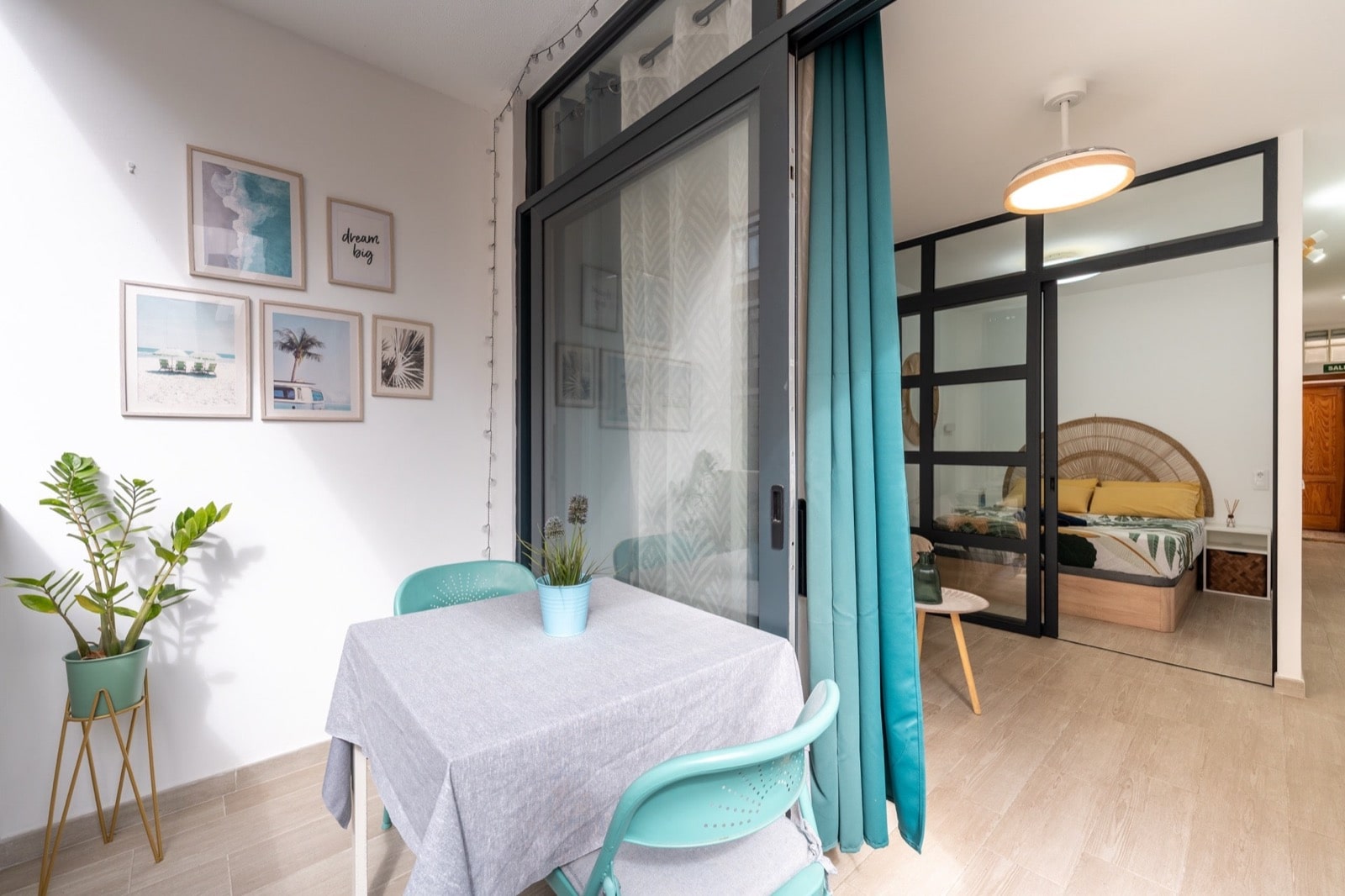
Casita Palmera, located 30 metres from Las Canteras beach, is the perfect base for your stay as a digital nomad. With 300 Mbps WiFi, a dedicated workspace and a terrace with sea views, you will have everything you need to work productively and enjoy island life.---
Comparison: Spain vs Portugal vs EU Blue Card
If you are evaluating different options for living and working legally in Europe, here is a comparison of the most relevant programmes.
Spain Digital Nomad Visa vs Portugal D7/D8
| Aspect | Spain (Digital Nomad) | Portugal D7 | Portugal D8 |
|--------|----------------------|-------------|-------------|
| Type | Remote work | Passive income/remote | Digital nomad |
| Minimum income | €2,520/month | €820/month (PT min. wage) | €3,510/month (4x min. wage) |
| Tax benefit | Beckham Law (24%) | NHR (20% reduced rate) | NHR (20% reduced rate) |
| Initial duration | 1-3 years | 2 years | 1 year |
| Renewal | Up to 5 years | Renewable | Renewable |
| Processing | 20 business days | 2-4 months | 1-2 months |
| Permanent residency | After 5 years | After 5 years | After 5 years |
EU Blue Card
The EU Blue Card is an alternative for highly qualified professionals, but it has significant differences:
- Requires a contract with an EU-established company (remote work for a non-EU company is not eligible)
- Minimum salary: Approximately €37,000-€42,000/year (varies by country)
- Advantage: Allows mobility between EU countries
- Disadvantage: Does not include special tax benefits
For most digital nomads, Spain's visa offers the best combination of tax benefits, quality of life and ease of application.
---
Frequently Asked Questions
Can I apply if I am an EU citizen?
No, EU/EEA citizens already have the right to live and work freely in Spain. This visa is designed for non-EU nationals. However, EU citizens can benefit from the Beckham Law regime if they meet the requirement of not having been tax residents in Spain during the previous 5 years.
Can I bring my family?
Yes. The visa allows family reunification for your spouse, minor children and dependent parents. Each family member needs their own application, but they are processed together. Family members do not need to meet the income requirement individually.
Can I work for Spanish clients?
Yes, but with limitations. A maximum of 20% of your total income may come from clients or companies established in Spain. The remaining 80% must come from foreign sources.
What if my income is variable (freelancer)?
Your average income over the past 12 months is evaluated. If your average exceeds €2,520/month, you meet the requirement. It is advisable to provide bank statements and invoices that demonstrate the regularity of your income.
Can I apply while already in Spain on a tourist visa?
Yes, it is possible to apply for the residence permit directly in Spain through the UGE-CE if you are already in the country on a valid tourist visa. This speeds up the process by avoiding consular processing.
How long can I be absent from Spain?
To maintain your residency, you must not be absent from Spain for more than 6 consecutive months. To obtain permanent residency after 5 years, total absences must not exceed 10 months during that period.
Do I need to open a Spanish bank account?
It is not a visa requirement, but it is highly recommended. You will need a Spanish account to pay taxes, receive utility bills and manage your daily life. Digital banks like N26 or Revolut can serve temporarily, but a local bank makes bureaucratic procedures easier.
How does Social Security work?
With the digital nomad visa, you must register as self-employed (autónomo) with Spanish Social Security or demonstrate that you contribute to your home country's social security system through a coverage certificate. The self-employed contribution in 2026 starts at approximately €230/month, depending on your contribution base.