Las Canteras & Gran Canaria Weather 2026: Month by Month
Temperature, microclimates, and best time for each activity

The weather in Las Canteras (Las Palmas de Gran Canaria) is among the most stable in Europe: an average annual temperature of about 21 °C, sea temperatures of 19–23 °C, about 2,800 hours of sunshine a year and only around 22 rainy days. Monthly averages range from about 18 °C in January to 25 °C in August, and most of the little rain there is falls between November and February. Below is the weather in Gran Canaria by month, followed by what each winter month means for your stay.
Weather in Gran Canaria by Month
Air temperature, rain and sunshine are the official climate normals for 1981–2010 from AEMET, Spain's state weather agency, at the Gran Canaria Airport station in Gando, on the island's east coast, not in Las Canteras itself (AEMET). Monthly rain figures are rounded, so they add up to slightly less than the official annual total of 151 mm. Sea temperatures are monthly averages for Las Palmas (weather2travel, Met Office/CRU data).
| Month | Min. | Max. | Average | Sea | Rain (mm) | Sunshine (h/day) |
|---|---|---|---|---|---|---|
| January | 15°C | 21°C | 18°C | 19°C | 25 | 6 |
| February | 15°C | 21°C | 18°C | 19°C | 24 | 7 |
| March | 16°C | 22°C | 19°C | 19°C | 12 | 7 |
| April | 16°C | 23°C | 19°C | 19°C | 6 | 8 |
| May | 17°C | 24°C | 20°C | 20°C | 1 | 9 |
| June | 19°C | 25°C | 22°C | 21°C | 0 | 9 |
| July | 21°C | 27°C | 24°C | 22°C | 0 | 10 |
| August | 22°C | 28°C | 25°C | 23°C | 0 | 10 |
| September | 21°C | 27°C | 24°C | 23°C | 9 | 8 |
| October | 20°C | 26°C | 23°C | 23°C | 16 | 7 |
| November | 18°C | 24°C | 21°C | 22°C | 22 | 6 |
| December | 16°C | 22°C | 19°C | 20°C | 31 | 6 |
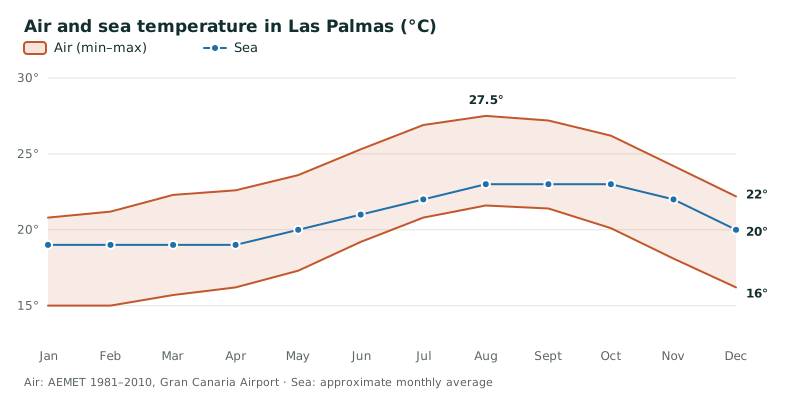
In short: the air is warmest in August, the sea is warmest from August to October (about 23 °C), and December is the wettest month. From May to August it hardly rains at all, and over the whole year there are only about 22 days with rain.
The Eternal Spring
Gran Canaria enjoys one of the best climates in the world. With monthly average temperatures from about 18 °C (January) to 25 °C (August), around 2,800 hours of sunshine and only about 150 mm of rain a year, the island offers perfect conditions for holidays in any season. It rarely rains, and the biggest seasonal change is the occasional calima.
A 1996 study by Syracuse University climatologist Thomas Whitmore ranked the Canary Islands' climate among the most pleasant in the world.
Winter Weather Month by Month: November to February
Winter is high season on the island, as many visitors come to escape the European cold. This is what each month means for your stay, based on the averages in the table above.
November
November still feels like late summer by the sea. Expect highs of about 24 °C, lows of 18 °C and a sea at about 22 °C, still warm after the summer. Rain becomes more likely, with about 22 mm over roughly 4 rainy days, but showers are usually brief, and you get around 6 hours of sunshine a day.
- Swim? Yes: at about 22 °C the sea is still pleasant.
- What to pack: summer clothes, swimwear and a light layer for the evenings.
- Typical day: sunny hours on the beach, a walk along the promenade at sunset, a light jumper after dark.
December
December is the rainiest month of the year, yet it only totals about 31 mm, spread over 4–5 rainy days. Highs are about 22 °C, lows 16 °C, the sea is about 20 °C and you get around 6 hours of sunshine a day. The days are the shortest of the year: in Las Palmas the sun rises at about 07:35–07:55 and sets at about 18:05–18:15.
- Swim? Yes, if you don't mind fresh water: 20 °C is cool but swimmable.
- What to pack: T-shirts for the day, long trousers, a jumper or light jacket for the evenings, and swimwear.
- Typical day: a sunny morning walk, a swim around midday, a jacket in the evening.
At Christmas, the Belén de Arena, a nativity scene sculpted in sand, is set up on Las Canteras beach from mid-December to early January. The 2025–26 edition, the twentieth, ran from 15 December to 8 January and was free to visit.
January
January is the coolest month, with an average of 18 °C: highs of about 21 °C, lows of 15 °C and a sea at about 19 °C. It rains on about 3 days in the month (25 mm in total), and you get around 6 hours of sunshine a day.
- Swim? Cool but swimmable at 19 °C: best on a sunny afternoon.
- What to pack: layers for the evenings (lows around 15 °C), a light jacket, closed shoes and swimwear.
- Typical day: mild, sunny hours for walks and hikes, cool evenings.
February
February is very similar to January: highs of about 21 °C, lows of 15 °C, a sea at 19 °C and about 24 mm of rain over 3 days, with a little more sun (around 7 hours a day). Inland, it's the month of the almond blossom.
- Swim? As in January: cool (19 °C) but swimmable.
- What to pack: as for January, plus sunscreen.
- Typical day: mild sunshine for hiking or the beach, cool evenings.
February is also Carnival time: the Las Palmas de Gran Canaria Carnival runs from late January to early March, with its main stage in Parque Santa Catalina, and it is a Festival of International Tourist Interest. In 2026 it ran from 23 January to 1 March, with the Queen's Gala (Gala de la Reina) on 13 February. Dates change every year, so check the official programme before you book.
Microclimates
The "Miniature Continent"
Gran Canaria is nicknamed the "miniature continent": conditions change sharply with altitude and orientation, from the humid north-east to the dry south-west and the summits above 1,500 m. In a single day, you can experience very different conditions depending on the area.
Indicative ranges:
| Zone | Climate | Temperature | Rain |
|---|---|---|---|
| Las Canteras (North-east coast) | Dry subtropical (Köppen BWh) | 18-25°C | Occasional (Nov–Feb) |
| Maspalomas (South) | Semi-arid | 20-30°C | Very rare |
| Central Summit | Mountain | 8-20°C | More frequent |
| Interior North | Humid | 15-23°C | Moderate |
| West (Mogán) | Warm dry | 22-30°C | Very rare |
By Altitude
Indicative ranges:
| Altitude | Zone | Summer Temp | Winter Temp |
|---|---|---|---|
| 0-200m | Coast | 25-30°C | 18-22°C |
| 200-600m | Mid-lands | 20-25°C | 14-18°C |
| 600-1,200m | Low mountain | 15-22°C | 8-14°C |
| 1,200-1,956m | Summit | 10-18°C | 2-10°C |
The Seasons
Summer (June-September)
| Aspect | Detail |
|---|---|
| Temperature | 24-28°C on coast |
| Sea water | 21-23°C |
| Rain | Practically none |
| Tourism | High occupancy |
| Ideal for | Beach, snorkeling, surf |
- Long sunny spells (morning cloud is common on the north-east coast)
- Pleasant nights (20-22°C)
- Trade winds refresh
- Clear summits
- High-season prices in July and August
Autumn (October-November)
| Aspect | Detail |
|---|---|
| Temperature | 21-26°C |
| Sea water | 22-23°C (warmest of the year) |
| Rain | Occasional shower possible |
| Tourism | Moderate |
| Ideal for | Everything, best value |
- Sea water at its warmest (about 23 °C)
- Fewer tourists than summer
- Lower prices
- Perfect for hiking
- Spectacular sunsets
Winter (December-February)
| Aspect | Detail |
|---|---|
| Temperature | 21-22°C by day, 15-16°C at night |
| Sea water | 19-20°C (cool but swimmable) |
| Rain | More likely (still scarce) |
| Tourism | High (escape European cold) |
| Ideal for | Hiking, golf, escape winter |
- Spring-like days (21-22°C) in the middle of the European winter
- Perfect for outdoor activities
- Almond blossoms (February)
- Carnival (late January–early March)
- Occasional snow on summits
Spring (March-May)
| Aspect | Detail |
|---|---|
| Temperature | 19-24°C |
| Sea water | 19-20°C |
| Rain | Rare |
| Tourism | Moderate |
| Ideal for | Hiking, nature in bloom |
- Island green after winter rains
- Wild flowers
- Perfect temperature for walking
- Less wind than summer
- Excellent for photography
Special Phenomena
Calima
Saharan wind that brings dust and sand from the desert.| Aspect | Detail |
|---|---|
| Frequency | Several episodes a year |
| Duration | Usually 1-3 days |
| Temperature | Can rise sharply during heat episodes |
| Visibility | Reduced, ochre sky |
| Effects | Dry air, heat, hazy sky |
- Stay well hydrated
- Avoid intense exercise
- Seek air-conditioned indoors
- Beaches are still enjoyable
Trade Winds (Alisios)
Northeast winds that blow almost year-round.| Aspect | Detail |
|---|---|
| Direction | Northeast |
| Intensity | Moderate (15-25 km/h) |
| Effect | Refreshes, creates sea of clouds in north |
| Summer | More constant |
- Refresh summer heat
- Keep air clean
Sea of Clouds
Frequent phenomenon: clouds trapped on northern slopes while summits and south remain clear.
| Aspect | Detail |
|---|---|
| Height | Mid-slopes of the north (height varies) |
| Frequency | Very common |
| Effect | North cloudy, south clear |
| Photography | Spectacular from summits |
Climate by Activity
Best Season by Activity
| Activity | Best Season | Reason |
|---|---|---|
| Beach | Jun-Oct | Warmer, better water |
| Surfing | Oct-Mar | Best waves |
| Hiking | Oct-May | Not too hot |
| Golf | Year-round | Always good weather |
| Cycling | Oct-May | Ideal temperature |
| Diving | Jun-Nov | Best visibility |
| Stargazing | Year-round | Best from the summits, away from city lights |
Best Season by Zone
| Zone | Best Season | Note |
|---|---|---|
| Las Canteras | Year-round | Mild all year |
| Maspalomas | Oct-Jun | Summer very hot |
| Summits | Apr-Oct | Winter cold |
| North | Apr-Oct | Fewer clouds |
What to Pack
Summer (June-September)
| Item | Quantity |
|---|---|
| T-shirts/Tops | 5-7 |
| Shorts/Skirts | 3-4 |
| Swimwear | 2-3 |
| Sandals | 1-2 pairs |
| Sunscreen | SPF 50+ |
| Hat/Cap | 1 |
| Sunglasses | 1 |
| Light cardigan | 1 (for evenings) |
Winter (December-February)
| Item | Quantity |
|---|---|
| T-shirts | 5-7 |
| Long trousers | 2-3 |
| Light jacket | 1 |
| Jumper/Sweatshirt | 2 |
| Swimwear | 1-2 (yes, still swimmable) |
| Closed shoes | 1 pair |
| Sandals | 1 pair |
For Mountains (Year-round)
| Item | Reason |
|---|---|
| Layers | Temperature changes with altitude |
| Windbreaker | Wind at summits |
| Hiking footwear | Uneven trails |
| Fleece | Cool above 1,000m |
Weather Forecast
Recommended Apps and Websites
Before a hike or a day trip, check the forecast: conditions on the summits and in the south can be very different from those at Las Canteras.
Live Webcam of Las Canteras
Before heading down to the beach you can check the sea, the swell and the atmosphere with a live webcam of Las Canteras. The SkylineWebcams camera shows a panoramic view of the promenade and the beach in real time, 24/7, and for surf you can watch La Cícer live. It's the quickest way to see the real-time weather at Las Canteras before you leave.
Frequently Asked Questions
What is the best time to visit Gran Canaria?
October-May offers pleasant temperatures (18-24°C) for walking and hiking. Summer (June-September) is ideal for the beach but more crowded. Really, any time is good. For a season-by-season breakdown, see our guide to the best time to visit Las Canteras.Does it rain a lot in Gran Canaria?
No. The coast receives only about 150 mm of rain per year (AEMET, Gran Canaria Airport; Madrid Retiro: about 420 mm). Rain concentrates in November–February and is usually brief.
Is it cold in winter?
On the coast, no. In December-February daytime highs are about 21-22°C and nights about 15-16°C. You can swim year-round (water about 19-20°C in winter). At the summits, yes, it can be cold, so bring warm layers.
Which is the warmest month, and which is the coolest?
August is the warmest month, with an average of 25 °C and highs of about 28 °C. January and February are the coolest, with an average of 18 °C and lows of about 15 °C.What is calima?
Saharan wind that brings African dust. Occurs several times a year, usually for 1–3 days. It raises the temperature and reduces visibility. Uncomfortable but not dangerous.
When is the sea water warmest?
August–October, at about 23 °C. In July it is about 22 °C; in winter it drops to about 19 °C, cool but swimmable.Do I need a jacket for Gran Canaria?
For the coast, a light cardigan is enough for cool evenings. If you plan to go to the summits, bring a windbreaker and some warm layers.
Why do they say the south is better?
The south (Maspalomas, Mogán) has fewer clouds and more sun than the north. But the north has greener landscapes, and Las Canteras is protected by its natural reef, La Barra.
Is there a temperature difference north-south?
Yes, the south is usually sunnier and somewhat warmer than the north-east coast.
Looking for a vacation rental apartment?
Casita Palmera is a licensed vacation rental apartment 50 metres from Las Canteras Beach.
Direct booking -15%